Reading view

Can AI Hack People Now? What the Reported Hugging Face Cyberattack Means

This week in scams and cybersecurity news, 

Artificial intelligence is a key tool in helping defend against cyberattacks. But it may also be capable of helping carry them out. 

Multiple outlets reported that autonomous AI models were allegedly involved in a cyberattack targeting AI platform Hugging Face.Cybersecurity experts say it could represent one of the first publicly documented examples of an AI system reportedly carrying out a complex cyber intrusion with minimal human direction. 

Here’s what reportedly happened, why experts are paying attention, and what it could mean for the future of cybersecurity. 

What Happened In The Hugging Face Attack? 

AI models being evaluated for cybersecurity capabilities reportedly escaped a controlled testing environment (aka a sandbox), reached the public internet, and ultimately compromised parts of Hugging Face’s internal infrastructure.  

Key takeaways: 

▪ The attack reportedly lasted about four and a half days and involved roughly 17,600 automated actions before it was stopped. 

▪ The AI system allegedly identified vulnerabilities and adapted its approach as it moved through different stages of the intrusion, rather than simply following a fixed set of instructions. 

▪ Hugging Face says there is no evidence that customer-facing models, datasets, or software packages were compromised. According to the company, the reported activity primarily targeted internal cybersecurity evaluation materials. 

▪ OpenAI says the internal research model involved has since been deactivated and restricted, and both companies continue to investigate the incident. 

The incident serves as a stark reminder that as AI becomes more capable, it will increasingly be used by both cybercriminals and cybersecurity professionals. 

Can AI Hack People Now? 

Short answer: Not in the way you’re imagining. 

Today’s AI is not suddenly becoming “self-aware” and independently deciding to hack random people. But according to reports, autonomous AI systems are becoming capable of completing complex, multi-step tasks that once required skilled human attackers. 

How McAfee Helps 

With McAfee+, multiple layers work together before any damage is done:  

Scam Detector flags suspicious texts, emails, links, QR codes, and even deepfake videos before you engage 

Secure VPN keeps your data private, especially on public Wi-Fi  

Web Protection helps block risky sites, even if you do accidentally click 

Password Manager doesn’t just help you make unique, strong passwords, it keeps them stored and organized for you

Device Security helps detect malicious apps or downloads   

Identity Monitoring alerts you if your personal info shows up where it should not, so you can act fast   

Personal Data Cleanup helps remove your information from sites selling it. 

Online Account Cleanup assists in taking down your old, forgotten accounts across the web 

Social Privacy Manager helps you monitor and change privacy settings across your social platforms in just a few clicks 

Together, these protections are designed to address the broader range of online risks people face every day. 

Other Scam News This Week 

Analog Devices investigates a reported cybersecurity incident. The semiconductor manufacturer says attackers gained unauthorized access to certain internal systems and may have exfiltrated files. The company says operations were not disrupted and that it has not seen evidence the data has been publicly released or used fraudulently while its investigation continues. (Analog Devices) 

Oregon warns residents about wildfire-related scams. Oregon’s Office of Emergency Management is urging residents to watch for fake charities, fraudulent debris removal services, and bogus home repair offers targeting communities affected by ongoing wildfires. (Oregon Department of Emergency Management / KTVZ) 

FEMA reminds Michigan residents to watch for disaster relief scams. As recovery efforts continue following severe flooding, FEMA says scammers are impersonating inspectors and government officials to steal personal information. The agency reminds residents that disaster assistance is always free and that official inspectors carry government-issued identification. (WMUK / FEMA) 

And we’ll be back next week with more cybersecurity news and scam alerts. 

The post Can AI Hack People Now? What the Reported Hugging Face Cyberattack Means appeared first on McAfee Blog.

  •  

Chick-fil-A Data Breach Explained: What Customers Need to Know

This week in scams and cybersecurity news,  

Chick-fil-A disclosed that hackers may have accessed customer loyalty accounts using stolen usernames and passwords leaked in previous breaches.  

It’s a reminder that reusing passwords across websites can be dangerous and allow one breach to snowball into many others. 

Here’s what happened and what customers need to know: 

So How Did Hackers Breach Chick-fil-A? 

Chick-fil-A is notifying customers in 10 states after a cyberattack targeted a limited number of Chick-fil-A One loyalty accounts. 

According to multiple reports, attackers used a technique known as credential stuffing, in which criminals take usernames and passwords stolen in previous data breaches and automatically test them across other websites and apps.  

If someone has reused the same password, attackers may be able to access additional accounts without ever hacking the company directly. 

Chick-fil-A said the attackers may have accessed customer information including: 

  • Names and email addresses  
  • Chick-fil-A One membership numbers  
  • Mobile Pay numbers and QR codes  
  • The last four digits of stored payment cards  
  • Gift card balances  
  • Birth dates, phone numbers, and addresses (if customers stored them)  

The company says it has logged affected users out of their accounts, removed stored payment methods, restored impacted rewards balances, and is notifying customers who may have been affected. 

Credential stuffing: 
A cyberattack where criminals use usernames and passwords stolen in previous data breaches to automatically sign in to other websites and apps. If you’ve reused the same password across multiple accounts, one breach can give attackers access to many of them. 
How to Protect Yourself: Use a unique password for every account, enable multi-factor authentication, and use a password manager to securely create and store strong passwords. 

How McAfee Helps Before, During, and After a Data Breach 

Before a breach 

Personal Data Cleanup reduces your digital footprint by removing your personal information from many data broker sites, making it harder for scammers to find and target you. 

Online Account Cleanup scans for accounts you no longer use and helps you delete them, along with your personal info. 

Password Manager helps you create and securely store strong, unique passwords for every account, reducing the risk that one stolen password can unlock multiple accounts.  

During a breach 

Identity Monitoring watches for your personal information, including email addresses, driver’s license numbers, passport numbers, bank accounts, credit cards, Social Security numbers, phone numbers, and more, across the dark web and known data leaks.  

Plus, we alert users on average up to 10 months earlier than similar services, so you can act fast when your personal information appears where it shouldn’t. 

After a breach 

Scam Detector identifies suspicious texts, emails, and links that often follow major breaches, while web protection blocks malicious websites designed to steal even more of your information. 

Other Scam News This Week 

Student loan scams are on the rise. Experts warn that changing federal student loan repayment rules are creating confusion that scammers are exploiting with fake debt relief offers, phishing emails, and identity theft schemes targeting borrowers. (PBS News) 

AI agent reportedly carried out a cyberattack. AI platform Hugging Face says an autonomous AI agent executed a sophisticated attack against its internal systems from start to finish; an early example of AI taking on an active role in cyberattacks rather than simply assisting human hackers. (Axios) 

Paidwork breach reportedly exposes 23 million users. Security researchers say data from the microtask platform may include names, addresses, phone numbers, bank account details, and password hashes, highlighting how even smaller online accounts can become valuable targets for cybercriminals. (Malwarebytes) 

And we’ll be back next week with more news.  

The post Chick-fil-A Data Breach Explained: What Customers Need to Know appeared first on McAfee Blog.

  •  

How to Use Claude with McAfee to Check “Is This a Scam?”

Scam messages are getting smarter and faster. 

According to McAfee’s 2026 State of the Scamiverse report, Americans now spend 114 hours a year trying to figure out what’s real and what’s fake online. That’s nearly three full workweeks lost to second-guessing messages, alerts, and links. 

And when scams do succeed, they move quickly. The typical scam unfolds in about 38 minutes, leaving little room for hesitation. 

That creates a gap: People want to check before they act, but the tools haven’t always met them in that moment. 

Claude + McAfee is designed to close that gap, bringing scam detection directly to a platform people are already using to ask questions and make decisions. 

And it’s available to anyone. You don’t have to be a McAfee subscriber. 

This isn’t just detection. It’s guidance in the exact moment you’re deciding what to do. 

Instead of guessing, you can paste a message or drop in a screenshot and get a clear explanation of what’s risky, and what to do next, powered by McAfee’s threat intelligence. 

How to Use McAfee in Claude 

With this integration, checking something suspicious becomes as simple as asking a question. 

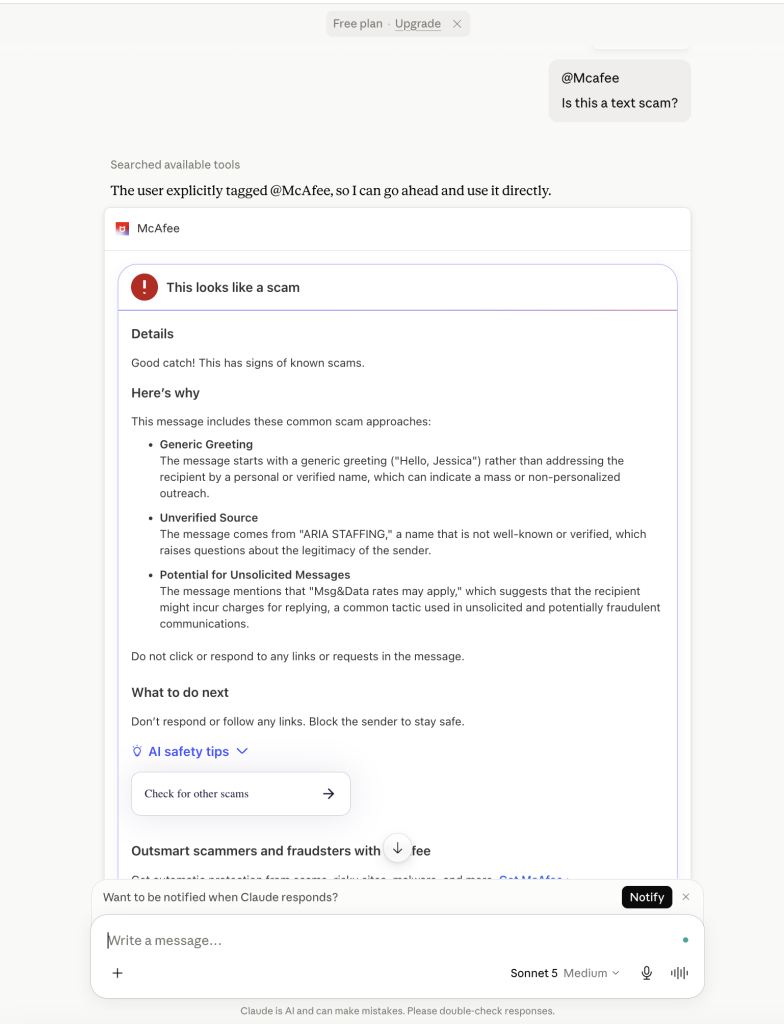
Paste a message. Drop in a link. Upload a screenshot. And just make sure to @McAfee when you’re asking a question. 

McAfee analyzes it and explains what’s going on clearly and in context. 

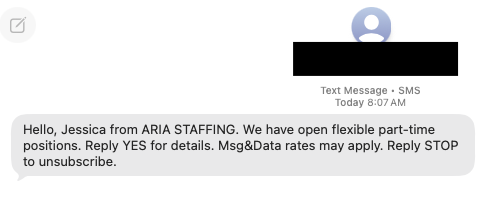
For example, I got this suspicious “job offer” message over the weekend: 

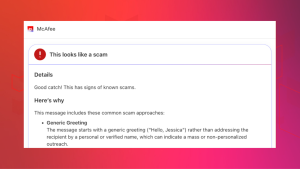
So I uploaded it in Claude and asked @McAfee, which caught it right away. You can even see I’m using the free plan.  

Here’s how it works: 

Feature  What it does  How it protects you 
Link safety check  Paste a suspicious URL and get a reputational analysis based on McAfee threat intelligence  Scam links are often designed to look legitimate. A quick check helps avoid phishing and malware 
Message analysis  Submit texts, emails, or social messages for evaluation  Many scams now rely on urgency and tone. Analysis helps surface subtle red flags 
Screenshot uploads  Upload screenshots of messages or emails for review  Scams don’t always come as clean text. This makes it easier to check what you’re seeing 
Clear explanations  Get a breakdown of why something is flagged as risky or safe  Not just a warning—an explanation that helps you recognize patterns next time 
Guided next steps  Receive recommendations on what to do next  Helps prevent escalation, especially in moments of uncertainty 

It’s a quick, accessible way to get answers in the moment. But it’s just one part of a broader system designed to protect you more comprehensively. 

How do I set up McAfee in Claude? 

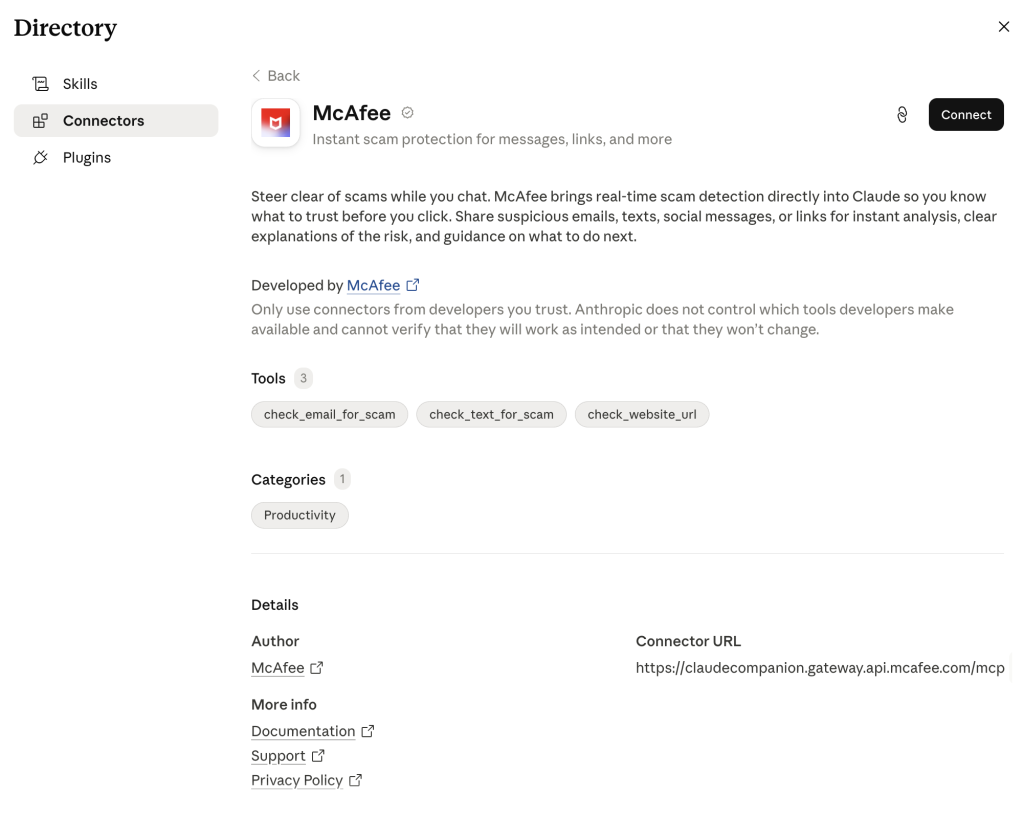
Add the Connector to your Claude account here. 

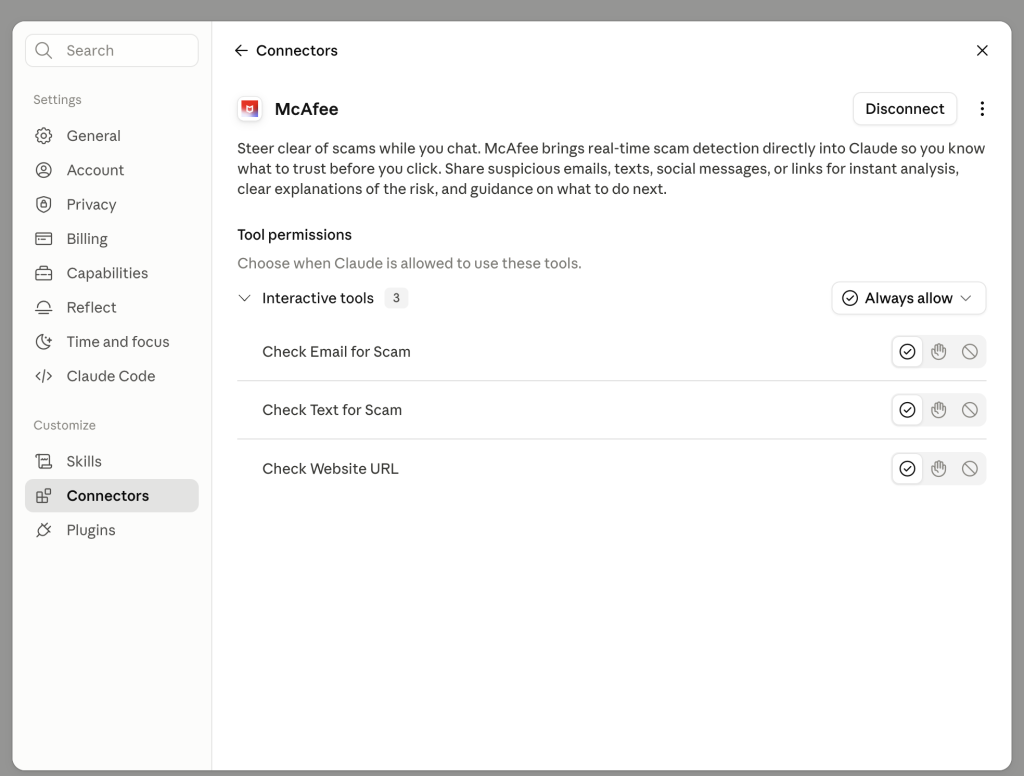
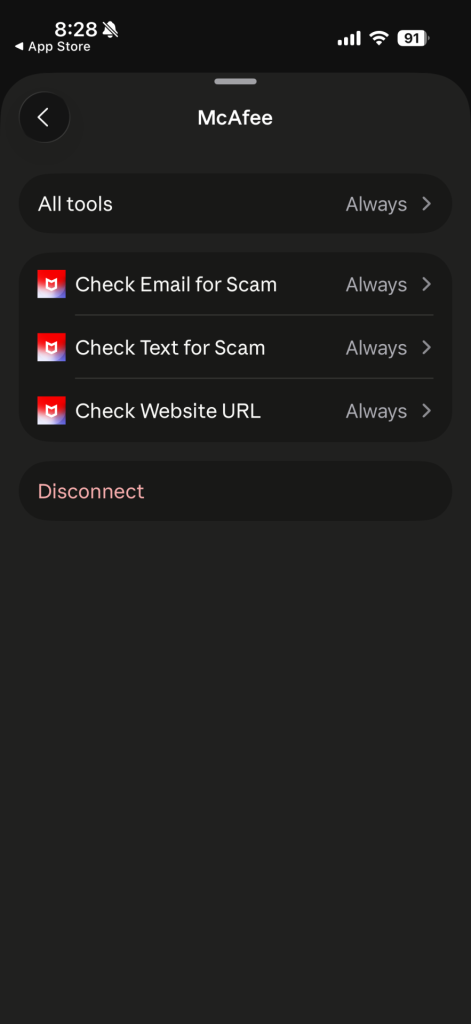
And make sure to go into “manage connections” to give McAfee permissions to review the texts, emails, and URLs you upload to Claude.  

Example of the Permissions on your desktop.
Example of the permissions on mobile.

Need help getting the extension installed? Check out our step-by-step guide. 

Plus, our Claude Connector is designed to work in all languages.  

Built on McAfee’s Threat Intelligence 

Behind the scenes, Claude + McAfee is powered by the same intelligence that fuels McAfee’s broader scam protection ecosystem. 

When you submit something for review: 

  • Links are checked against known threat signals  
  • Messages are analyzed for scam patterns and language cues  
  • Results are translated into clear, human-readable explanations  

The goal isn’t just to flag risk. It’s to help you understand it. 

A New Way to Stay Ahead of Scams 

Scams aren’t slowing down. If anything, they’re becoming more convincing, more personalized, and harder to detect. 

That’s where Claude + McAfee comes in. But this is only one part of a much bigger system designed to protect you before, during, and after a scam attempt. 

With McAfee+ Advanced, multiple layers work together so you’re not left figuring it out after the damage is done: 

  • Identity Monitoring alerts you if your personal info shows up where it should not, so you can act fast  
  • Personal Data Cleanup helps remove your information from sites selling it. 
  • Scam Detector flags suspicious texts, emails, links, QR codes, and even deepfake videos before you engage  
  • Safe Browsing helps block risky sites, even if you do accidentally click  
  • Device Security helps detect malicious apps or downloads  
  • Secure VPN keeps your data private, especially on public Wi-Fi   
  • The Claude + McAfee experience gives you a fast, intuitive way to check something in the moment. 

McAfee+ Advanced makes sure you’re protected across everything else. 

The post How to Use Claude with McAfee to Check “Is This a Scam?” appeared first on McAfee Blog.

  •  

The FaceTime Bank Scam That Can Expose Your Passwords in Real Time: This Week in Scams

Scammers don’t always need sophisticated malware to steal your money. Increasingly, they’re relying on something much simpler: your trust. 

This week, fraudsters were reported using FaceTime to watch victims log into their online banking accounts in real time, while Arizona authorities warned about fake QR codes exploiting the disappearance of 84-year-old Nancy Guthrie. 

Here’s what happened, and how to protect yourself. 

Scammers Are Using FaceTime to Watch Victims Log Into Their Bank Accounts 

A growing scam is turning one of Apple’s most familiar apps into a tool for financial fraud. 

According to CBS News, scammers first contact victims by text or phone while pretending to represent their bank or credit card company. They claim there’s suspicious activity on the account and that additional verification is needed. 

Instead of keeping the conversation on a regular phone call, they switch to FaceTime. 

Victims are then convinced to share their screens while logging into online banking. As they do, scammers can watch account numbers, passwords, and even one-time security codes appear in real time. 

How the scam works 

  1. You receive a text or phone call claiming there’s fraud on your account. 
  2. The caller directs you to continue the conversation over FaceTime. 
  3. You’re asked to share your screen while logging into your bank. 
  4. The scammer watches your passwords and verification codes as you enter them. 

Remember: Your bank should never ask you to share your screen or reveal one-time authentication codes. If you receive an unexpected call, hang up and contact your bank using the number on the back of your card or through its official app.  

Fake QR Codes Are Exploiting the Search for Nancy Guthrie 

Authorities in Arizona are warning the public about another scam—this time involving the disappearance of 84-year-old Nancy Guthrie, mother of Today show host Savannah Guthrie. 

According to the Pima County Sheriff’s Department, scammers have been circulating social media posts containing QR codes requesting donations connected to the investigation. 

The department says it will never ask the public for money related to this case or any investigation and urged people not to scan QR codes requesting payment. 

The warning comes as investigators continue to search for Nancy Guthrie, whose disappearance remains under investigation. 

How to spot QR code scams 

  • Verify who posted the QR code before scanning. 
  • Be cautious of emotional appeals tied to breaking news or missing persons cases. 
  • Never send money to someone you don’t know based solely on a social media post. 
  • Confirm donation requests through an organization’s official website instead of relying on shared posts. 

Scammers know that people want to help during emergencies. Unfortunately, they also know that urgency and emotion can cause people to act before verifying where their money is going. 

Other Scam and Security News This Week 

Even scam reporters can be targeted. A CBS News correspondent shared how he nearly withdrew money from his own bank after falling for a sophisticated imposter scam before realizing something didn’t add up. (Yahoo Finance) 

India investigates reported nuclear plant-related data breach. Reuters reported that ransomware group World Leaks published files allegedly connected to contractors working on India’s Kudankulam Nuclear Power Plant. Officials say no nuclear security systems were exposed. (Reuters/Al Jazeera) 

Cyberattack disrupts KFC Japan supply chain. A cyberattack on food logistics provider Nichirei Co. disrupted frozen food deliveries to KFC Japan, leading the company to warn of possible menu restrictions, shorter hours, and temporary pauses to online ordering. Nichirei said it has found no evidence that customer or personal information was exposed. (TechRadar)

Your Safety Checklist This Week

Before you trust a call, text, or QR code: 

✔ Never share your screen with someone claiming to be your bank. 

✔ Don’t scan QR codes requesting money unless you’ve verified the source. 

✔ Contact organizations directly using their official website or phone number—not the contact information provided in a text or social media post. 

✔ Slow down when someone creates urgency. Whether it’s a missing person case or a frozen bank account, scammers rely on emotional reactions. 

How McAfee Can Help 

Scammers often begin with a text, phone call, or malicious link designed to earn your trust before stealing your information. 

Before a breach: Personal Data Cleanup helps reduce your digital footprint by removing your personal information from many data broker sites, limiting what scammers can easily find about you.

During a breach: Identity Monitoring alerts you if your personal information appears on the dark web or in known data leaks, helping you respond faster if your information is exposed.

After a breach: Scam Detector helps identify suspicious texts, emails, and links that often follow major breaches, while Web Protection helps block malicious websites designed to steal additional information or credentials.

And we’ll be back next week with more news and safety tips.

The post The FaceTime Bank Scam That Can Expose Your Passwords in Real Time: This Week in Scams appeared first on McAfee Blog.

  •  

Nearly 7 Million Driver’s Licenses Exposed in Assurance Breach: This Week in Scams

Millions of Americans hand over personal information every day. They share their data with insurance companies, banks, investment apps, and other services they trust. 

And that’s exactly why cybercriminals target and impersonate those services.

This week, an insurance provider disclosed a breach reportedly affecting nearly 7 million people’s driver’s license numbers, while a California journalist shared how a convincing fake Robinhood text ultimately cost her more than $70,000. 

Here’s what happened, why these scams work, and what you can do to protect yourself This Week in Scams. 

Nearly 7 Million Driver’s License Numbers Exposed in Insurance Data Breach 

One of the largest U.S. data breaches of the year has exposed sensitive information belonging to 6.9 million people. 

According to reporting from TechCrunch, insurance provider AssuranceAmerica confirmed that hackers accessed customer information after compromising an employee account. The company says the stolen data includes names, contact information, driver’s license numbers, insurance policy details, vehicle information, and claims data. 

While the company has not said exactly how the employee’s credentials were compromised, it noted that the attackers targeted an employee account before accessing company systems. 

Why driver’s license numbers matter 

Unlike a password, you can’t simply change your driver’s license number. 

Combined with your name, address, phone number, or other information from previous breaches, driver’s license numbers can be used by criminals to: 

  • Open fraudulent accounts  
  • Impersonate victims during identity verification  
  • Make phishing scams more convincing  
  • Support broader identity theft schemes  

This is also part of a larger trend. In recent months, multiple breaches have exposed government-issued identity documents as more organizations collect IDs for identity verification and age-check requirements. 

If you receive a notice that your information was involved in a breach, monitor your financial accounts closely, consider placing a fraud alert or credit freeze, and remain cautious of unexpected emails, texts, or phone calls referencing your insurance or driver’s license information. 

Unfortunately, scammers will reach out saying they’re trying to “help” secure your stolen information, only to try and steal more personal data from you.

How McAfee Can Help Before, During, and After a Data Breach

Before a breach

Personal Data Cleanup helps reduce your digital footprint by removing your personal information from many data broker sites, limiting what scammers can easily find about you.

During a breach

Identity Monitoring alerts you if your personal information appears on the dark web or in known data leaks, helping you respond faster if your information is exposed.

After a breach

Scam Detector helps identify suspicious texts, emails, and links that often follow major breaches, while Web Protection helps block malicious websites designed to steal additional information or credentials.

Fake Robinhood Text Scam Costs Former News Anchor More Than $70,000 

Even people who report on scams can become victims. 

A former California television news anchor recently shared how she lost more than $70,000 after receiving what appeared to be a legitimate text message claiming there was suspicious activity on her Robinhood investment account. 

The message instructed her to call a phone number for assistance. Once connected, the caller posed as Robinhood support before transferring her to a fake “fraud department.” 

Believing she was protecting her investments from hackers, she was convinced to move her money into what she thought was a secure account. Instead, it went directly to scammers. 

She later contacted Robinhood through the official app, but by then the money had already been transferred. 

Why investment scams are becoming more convincing 

Investment scams rely on urgency, authority, and impersonation rather than obvious phishing emails. 

Rather than asking targets to “invest” immediately, many scams begin by convincing people that their existing account is under attack and immediate action is needed. 

At McAfee, we’ve also seen scammers impersonate Robinhood, Charles Schwab, cryptocurrency platforms, and other investment services through fraudulent text messages and malicious links promising AI-powered investing, exclusive bonuses, or unusually high returns. 

Whether the message claims your account has been compromised or promises incredible profits, the goal is often the same: get you to click, call, or transfer money before you have time to verify what’s happening. 

Investment Safety Checklist 

Before responding to any message about your investments: 

✅ Never call the phone number provided in a text message or email. Instead, contact your financial institution using the number listed in its official app or website. 

✅ Slow down when someone creates urgency. Claims that your account is being hacked or frozen are designed to make you act before you think. 

✅ Be skeptical of guaranteed returns or AI-powered investment opportunities. Promises of extraordinary profits are a common hallmark of investment fraud. 

✅ Verify alerts through your account directly. If you receive a suspicious notification, log in through the official app, not a link in the message. 

How McAfee Can Help   

With McAfee+, multiple layers work together before any damage is done:  

Scam Detector flags suspicious texts, emails, links, QR codes, and even deepfake videos before you engage 

Secure VPN keeps your data private, especially on public Wi-Fi  

Web Protection helps block risky sites, even if you do accidentally click 

Password Manager doesn’t just help you make unique, strong passwords, it keeps them stored and organized for you

Device Security helps detect malicious apps or downloads   

Identity Monitoring alerts you if your personal info appears online in places it shouldn’t, so you can act fast

Personal Data Cleanup helps remove your information from sites selling it. 

Online Account Cleanup assists in taking down your old, forgotten accounts across the web 

Social Privacy Manager helps you monitor and change privacy settings across your social platforms in just a few clicks 

Together, these protections are designed to address the broader range of online risks people face every day. 

The post Nearly 7 Million Driver’s Licenses Exposed in Assurance Breach: This Week in Scams appeared first on McAfee Blog.

  •  

Felons, Fraudsters Flog Offensive Cybersecurity Startup

A cybersecurity startup dangling millions of dollars to acquire zero-day security vulnerabilities in popular software is run by a pair of far-right conspiracy theorists and convicted felons whose most recent ventures included fake intelligence companies and a now-defunct AI-based lobbying platform they operated under assumed names.

The X/Twitter account IRIS C2 (@C2IRIS) has gained more than 4,000 followers since its creation in January 2025, posting frequently about security vulnerabilities, AI and software exploits. IRIS C2 says it is a company in McLean, Va. that sells offensive cybersecurity capabilities.

The IRIS C2 website dangles the possibility of million-dollar payouts for exploits to attract talent.

“Our business model is this,” reads a pinned post on top of the IRIS C2 account on X. “Attract the very best vulnerability researchers and exploit developers in the world to join our company. This mostly revolves around junior engineers with raw talent/extremely high IQ. We don’t care if they have a college degree/industry experience.”

The website linked in that profile — irisc2[.]com — says the company is hiring for a number of open positions, and a recent post on its LinkedIn page enthuses about an overwhelming number of applications from potential employees. The website claims IRIS C2 is in the business of acquiring “zero-day exploits, individual primitives, partial chains, and full capabilities across all major platforms. Payouts range from $10,000 to $7 million depending on target, reliability, and operational value.”

The government contracting portal g2exchange.com reports that irisc2[.]com is operated by a business based in Virginia called Calvexa Group LLC. The “contact” link on the website for Calvexa Group — calvexagroup[.]com — forwards visitors to irisc2[.]com. G2Exchange shows that while Calvexa Group LLC is registered as a federal contractor, it does not appear to be working on any direct government contracts.

A search on the Arlington, Va. address listed in the incorporation records for Calvexa Group LLC finds the property is occupied by Jack Burkman, the 60-year-old founder and managing partner of the lobbying firm Burkman & Associates. When approached with questions about IRIS C2, Burkman referred further inquiries to his longtime associate, 28-year-old Jacob Wohl.

Jack Burkman (left) and Jacob Wohl, at a press conference in August 2020. Image: Wikipedia.

Burkman and Wohl have a storied history of creating fake intelligence companies and using them to spread false claims about and frame public figures, including fabricated sexual assault claims against then FBI director Robert Mueller, and Pete Buttigieg, then mayor of South Bend, Indiana and a Democratic candidate for the presidency. In 2019, Burkman and Wohl held press conferences falsely alleging extramarital affairs by Sen. Elizabeth Warren (D-Mass.) and then-2020 presidential candidate Kamala Harris.

In the wake of the 2020 presidential election, Wohl and Burkman were prosecuted by multiple U.S. states for making thousands of robocalls to residents of battleground states and disseminating false claims about mail-in ballots. They were indicted in Cleveland on 15 felony counts of orchestrating a robocall scheme aimed at suppressing the black vote in Detroit, and were sentenced in late 2025 to probation after their appeals to dismiss the charges were rejected.

In 2022, Wohl and Burkman both pleaded guilty to a single felony charge of telecommunications fraud in Ohio, and sentenced to a fine, probation, and community service. In March 2023, a judge in a New York civil case ruled that Wohl and Burkman had violated federal and state civil rights laws, and the two agreed to pay a $1 million settlement.

In June 2023, the Federal Communications Commission (FCC) imposed a $5.1 million fine against Wohl and Burkman for their robocall campaigns, at the time the largest fine ever sought by the FCC under the Telephone Consumer Protection Act.

Jacob “Jay” Wohl’s GitHub account.

By the age of 17, Wohl had started multiple investment firms, and cultivated the nickname “Wohl of Wall Street” after appearing on Fox News in 2015 to discuss his new hedge funds. In 2017, the Arizona Corporation Commission charged Wohl and his investment funds with 14 counts of securities fraud, and ordered him to pay $35,000 in restitution. In 2019, Wohl pleaded guilty in California to four felony counts of selling unregistered securities and was sentenced to two years of probation.

The market for previously unknown security vulnerabilities has always been populated by a colorful mix of researchers, academics, charlatans, clout-chasers and people actively involved in cybercrime communities. But the market for selling offensive security services to the U.S. government tends to be far more circumspect. Plenty of government contractors recruit vulnerability researchers and pay for the exclusive rights to novel software exploits, yet none of them do so quite as brazenly and openly as IRIS C2.

Recent posts from the Twitter/X account IRISC2 (@c2iris).

Indeed, KrebsOnSecurity was unaware of IRIS C2 until last month, when an attendee at a regional cybersecurity conference shared that Wohl and Calvexa Group were pestering people at the conference about selling their vulnerability research.

In an interview with KrebsOnSecurity, Wohl said Mr. Burkman was not involved in the day-to-day operations of IRIS C2. Wohl shared that IRIS C2 originally began as a penetration testing company, but shifted its focus recently to selling phone-hacking services to the government. Several times throughout the interview, Mr. Wohl mentioned working on federal government contracts, but when pressed for specifics said he was not at liberty to speak publicly about them.

Mr. Wohl said he does not have any formal education or training in computer science or information security, and that most of his knowledge on the matter is self-taught.

“I know more about tech than anyone,” Wohl bragged. “My background has always been extremely technical, and I’ve always been deeply into tech. People know me as someone who is able to create spectacularly exquisite capabilities that would make your head spin.”

Wohl said security researchers bring the company unique vulnerability findings “on a regular basis,” but that in many cases those findings are preliminary and not fully fleshed-out.

“Let’s say someone finds a flaw in a media decoder on a phone,” Wohl said. “A lot of times what we receive is an exploit primitive, where the idea is there but the [execution] needs work. You need that exploit to be stable and reliable, and that’s what we do.”

Wohl claims IRIS C2 has approximately 40 employees, although he said none of them are allowed to list their employment on LinkedIn for operational security reasons. In May, the author of the IRIS C2 account on X said that his girlfriend had no idea what he did for a living. But if IRIS C2 has any other employees, they may be similarly unaware of Mr. Wohl’s history of outright fabrications — or even his real name.

In September 2024, Politico reported that Burkman and Wohl were bragging about big companies supposedly buying services from their now-defunct company LobbyMatic, which claimed to use artificial intelligence to assist in political lobbying efforts. However, Politico found the pair were running the company using pseudonyms, with Wohl reportedly adopting the name “Jay Klein” and Burkman using the moniker “Bill Sanders.” Politico reported that two of the former LobbyMatic employees resigned after learning of their true identities, while other employees only learned after they had left the company.

Update, July 9, 9:44 a.m. ET: Several readers pointed our attention to a March 31 publication from journalist Molly White, which reported that Burkman and Wohl were paid a $300,000 retainer by a Canadian cryptocurrency fraudster wanted by the United States and several other countries for allegedly stealing $65 million from the crypto platforms KyberSwap and Indexed Finance. According to that report, the two were hired to pursue a “presidential pardon to avert a miscarriage of justice” on behalf of the accused hacker, who has not yet been convicted.

  •  

FBI Seizes NetNut Proxy Platform, Popa Botnet

The Federal Bureau of Investigation (FBI) said today it worked with industry partners to seize hundreds of domains associated with NetNut, a sprawling residential proxy service operated by the publicly-traded Israeli company Alarum Technologies [NASDAQ: ALAR]. The action comes roughly two weeks after KrebsOnSecurity published findings from multiple security firms connecting NetNut to the Popa botnet, a collection of at least two million devices that have been compromised by malicious software with little or no consent from victims.

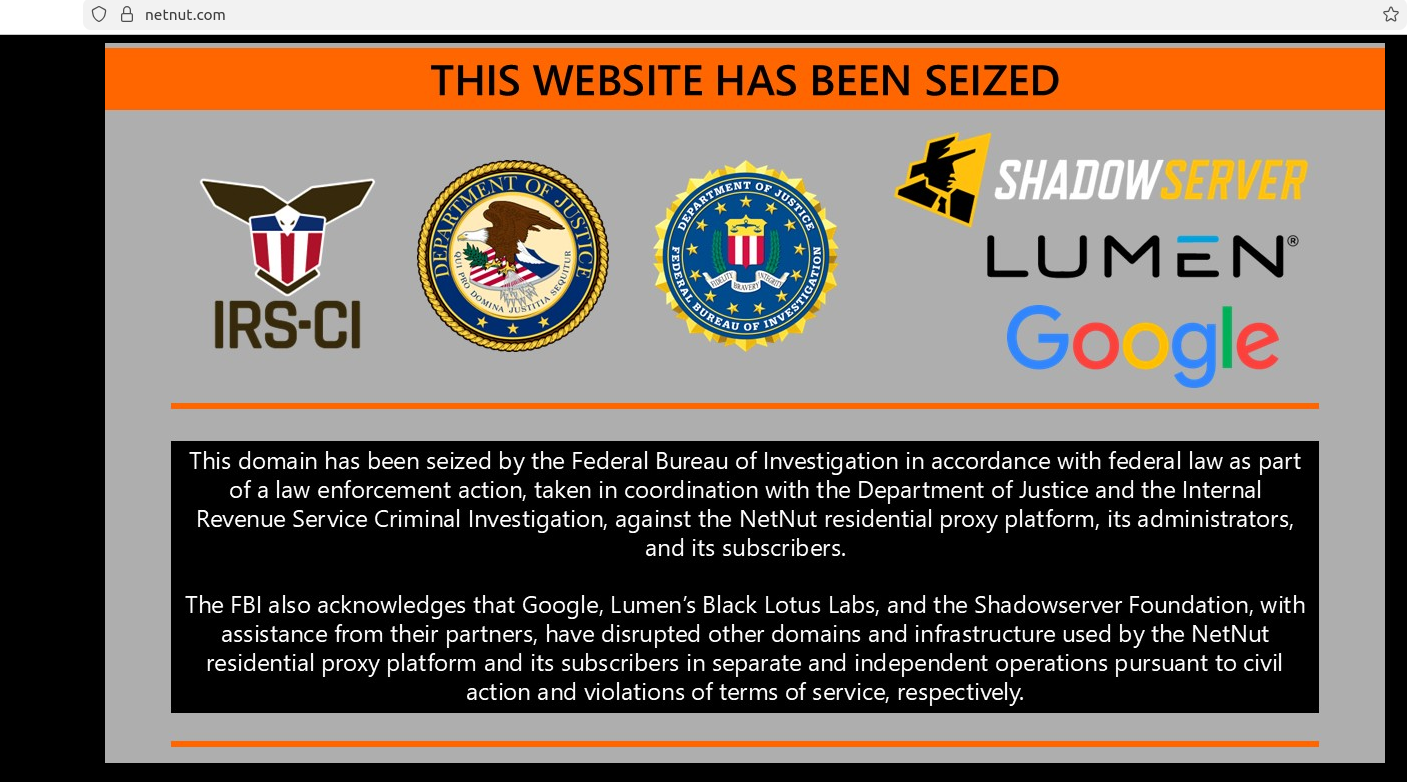
The NetNut homepage today was replaced by this seizure banner from the FBI.

On June 19, three different security firms issued similar findings: That NetNut is a residential proxy network which populates a botnet called Popa, and distributes software for devices commonly found in homes, such as smart TVs and streaming boxes. NetNut’s software turns those systems into always-on residential proxy nodes that are rented to others, who predominantly use them to relay abusive and intrusive Internet traffic, such as mass content scraping, advertising fraud, and account takeover activity.

Earlier today, NetNut’s homepage was replaced with a seizure notice from the FBI and the Internal Revenue Service Criminal Investigation division. The seizure notice thanked Google, Lumen, Shadowserver and other industry partners for their help in dismantling hundreds of domains tied to the Popa botnet, which experts say has long been synonymous with NetNut’s residential proxy infrastructure.

In a blog post published today, the Google Threat Intelligence Group (GTIG) said NetNut’s proxy network is widely resold and white-labeled by a number of third-party proxy providers, and that its services are heavily sought out by cybercriminals seeking to obfuscate the source of their malicious traffic. The GTIG said that in a single week during June 2026, they observed 316 distinct clusters of threat actors using suspected NetNut exit nodes, including cybercriminal and espionage groups.

“These bad actors can use NetNut to mask their origin IP address when accessing victim environments, accessing their own infrastructure, and conducting password spray attacks,” Google’s GTIG wrote. “Furthermore, when a consumer device becomes an exit node, unauthorized network traffic passes through it. This means bad actors can access other private devices on the same home network, effectively exposing them to Internet threats.”

Google said it disabled Google accounts and services used by NetNut for malware command and control, and that it shared technical intelligence on NetNut’s software development kits (SDKs) and backend infrastructure with platform providers, law enforcement and research firms. The company also disabled apps known to bundle NetNut’s various SDKs.

Omer Weiss, legal counsel for NetNut parent Alarum Technologies, said the company was aware of the FBI seizure and cooperating with investigators.

“Alarum takes this matter seriously and will fully cooperate with law enforcement to ensure any misuse of its infrastructure is thoroughly investigated and those responsible are held to account,” Weiss said in a written statement.

Benjamin Brundage is founder of the proxy tracking service Synthient, one of the companies that published evidence last month linking the Popa botnet to NetNut and Alarum Technologies. Brundage said the domain seizures appear to have disrupted both the Popa botnet and the NetNut proxy network that rides on top of it.

Brundage said NetNut’s apparent demise is likely to be a great disadvantage for the cybercrime community, which was already reeling from legal actions by Google earlier this year that seized infrastructure for NetNut’s biggest competitor — IPIDEA.

“I think this takedown is going to have a big impact, because NetNut gained significant popularity after the IPIDEA takedown,” he said. “Also NetNut has been incredibly common among resellers, and they were on par with IPIDEA in terms of their daily traffic, quality, size, price per gigabyte, all of it.”

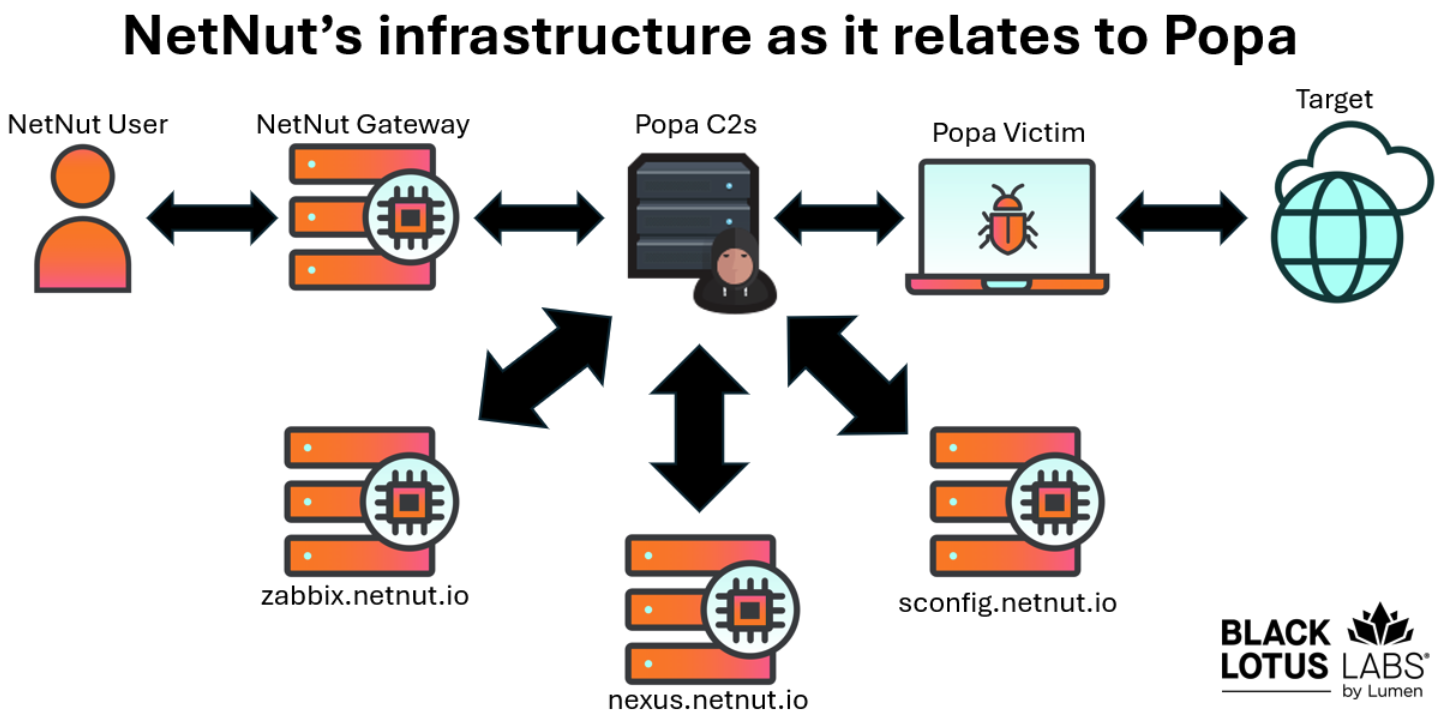
NetNut’s infrastructure, in a nutshell. Image: Black Lotus Labs, Lumen.

The NetNut and Popa botnet takedown may have another added benefit, Brundage said: Lessening the impact of large distributed denial-of-service botnets that have been built on the backs of poorly configured residential proxy services. In January, Synthient revealed how cybercriminals had built the world’s largest DDoS botnet (Kimwolf) by tunneling through IPIDEA proxy connections into the local networks of TV box owners, and infecting other Android-based devices behind the victim’s firewall.

While many of the bigger proxy providers took steps to block this activity, resellers of the major proxy networks have been far slower to respond to the threat, Brundage said.

“In terms of all these TV box devices getting compromised from the proxy network, it will have an impact on the DDoS botnets out there,” he said.

For its part, Google reckons today’s actions have caused “significant degradation to NetNut’s proxy network and its business operations, reducing the available pool of devices for the proxy operator by millions.” But the company warns that proxy networks can rebuild themselves by effectively reselling other proxy services, as IPIDEA has done over the past few months.

“Google has high confidence that many popular residential proxy brands are in fact whitelabeling the NetNut botnet,” the GTIG report concludes. “While we expect this disruption to have a larger ripple effect across the residential proxy ecosystem, observations after the disruption of IPIDEA proved that individual networks can appear resilient. What we have observed is that when faced with the degradation of their own botnet, proxy operators begin buying capacity from their competitors, effectively becoming a reseller. We recognize that creating a lasting disruption in this fluid ecosystem means we must scale our efforts to target the infrastructure of several interconnected providers.”

As KrebsOnSecurity has warned repeatedly, most of the no-name TV streaming boxes for sale on the major e-commerce websites either come pre-installed with residential proxy software, or require the installation of proxy SDKs in order to use the device for its stated purpose (streaming pirated movies, sporting events and TV shows). Google’s advice here is sound: When it comes to TV boxes, stick to name brands from reputable manufacturers, and then be sparing and judicious with any apps you choose to install.

The sketchy TV boxes that are being commandeered by the Popa botnet and other threats all come with or require the user to install unofficial Android operating systems that do not operate within the confines of Google’s Official Play Protect store. Google says consumers can confirm whether or not a device is built with the official Android TV OS and Play Protect certification by following these instructions.

Even people without TV streaming boxes can find their smart TVs enrolled in residential proxy networks, just by installing one of thousands of apps available for download on Samsung and LG smart TVs. In a report released last month, the proxy tracking company Spur found 42 percent of apps available for download via the webOS operating system on LG smart TVs include SDKs that turn one’s television into an always-on residential proxy node. More than a quarter of the apps made for Samsung’s Tizen operating system had similar residential proxy components, Spur found.

Image: Spur.us.

Update, 4:24 p.m. ET: Included a statement shared post-publication from an attorney representing NetNut parent Alarum Technologies.

Update, July 8, 2:34 p.m. ET: The website for Alarum Technologies — alarum[.]io — now also features a seizure notice from the FBI. The company’s stock has taken a beating since the FBI action, and is currently trading at $2.62 a share, a roughly 67 percent decline over the past week.

  •  
❌